Ask ten gamblers why they play and you'll get ten different answers. Some chase the adrenaline rush of a slot machine spinning its final reel. Others want the slow, cerebral grind of a poker table where every decision matters. And a third group simply enjoys the free drinks and the buzz of a live casino floor. What ties all of them together is a single question that never quite goes away: how much of this is skill, and how much is just dumb luck?
That question isn't academic. It shapes which games are worth your time, how you should bet, and whether you'll still be playing in five years with your bankroll intact. Let's break down the real mechanics behind the games most people play.
Every casino game has a built-in mathematical advantage for the house. That's not a scam; it's the business model. The variation between games, though, is enormous.
Consider blackjack played with basic strategy. The house edge can be as low as 0.5%. That means for every $100 you wager over time, you statistically lose about 50 cents. Compare that to American roulette, where the double zero pads the house edge to 5.26%. Same table felt, same chips, wildly different economics.
Slot machines are the murkiest of all because modern video slots don't publish their RTP as clearly as table games do. A typical slot might return 94-96% to players over millions of spins, which sounds fine until you realize that a 4% house edge on a $2 spin every five seconds adds up fast. Land-based slots in some jurisdictions can dip into the 85-90% range. Online slots usually run higher, often 95-97%, because operators face less overhead and more competition.
Here's the practical takeaway: if you're picking a game purely to lose money slowly, slots and specialty bets are not the choice. Video poker, baccarat, and basic-strategy blackjack are the friends of a long bankroll.
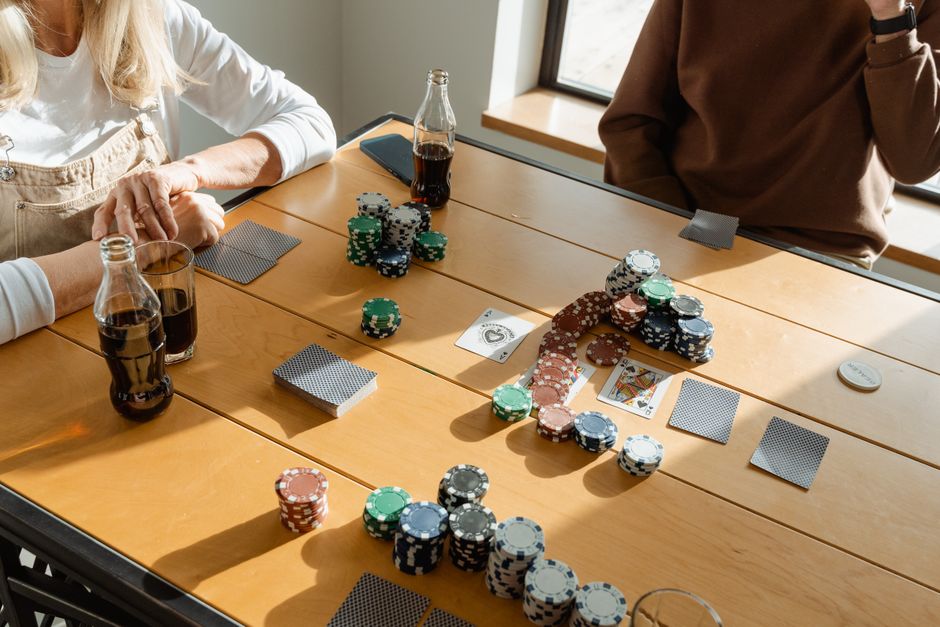
Poker is the elephant in the room. Unlike almost every other casino game, poker is played against other players, not the house. The casino takes a rake, but the money on the table changes hands based on decision quality over time.
This is why poker has produced generations of professionals while slots have produced none. A skilled player in a soft game can sustain a positive expected value over thousands of hands. That doesn't mean every session is a winner. Variance is brutal in the short term, and even a world-class player can lose for months. But the underlying math rewards better decisions.
Skill also matters in blackjack, but only to a point. Card counting can flip the house edge in your favor, but casinos actively defend against it, and the edge is thin even when executed perfectly. For most recreational players, basic strategy is the realistic ceiling. Learn it cold and you'll lose less than 95% of the people at the table.
Sports betting sits somewhere in the middle. Sharp bettors who understand line movement, injuries, and public bias can find value. Casual bettors who throw money on their favorite team because of a gut feeling are playing a lottery with extra steps.
Slot machines use random number generators, and every spin is independent of the last. That's the part players struggle with most. Ten consecutive losses do not make a win more likely. The machine has no memory.
What slots do have is volatility, and volatility is the real reason people feel like they're "due." A high-volatility slot might pay nothing for hundreds of spins and then dump a massive win. A low-volatility game pays smaller amounts more frequently. Neither is more or less likely to be profitable overall. They just feel different.
A few things worth knowing: If this is new to you, สล็อตเว็บตรง is a sensible next read.
None of that makes slots a bad way to spend an evening. It just means you should treat them as entertainment with a known cost, not as a strategy.
Here's the uncomfortable truth: whether you're playing poker, blackjack, or penny slots, the single most important skill is managing your money. Players who don't do this blow up regardless of their game knowledge.
Some concrete guidelines that actually hold up:
Professional poker players talk about bankroll management more than they talk about hand ranges, and there's a reason. Surviving variance is the prerequisite for everything else.
Casinos are engineered to exploit cognitive biases, and they're very good at it. The near miss on a slot reel, where two jackpot symbols land and the third stops just short, triggers the same dopamine response as a win. The loss disguised as a gain keeps people spinning.
In poker, the equivalent is results-oriented thinking, where players judge a decision by whether it won the hand rather than whether it was mathematically correct. A call with 20% equity that hits on the river can be a terrible play and still pay off. That doesn't make it right.
Sports bettors fall for the recency bias, overvaluing a team's last three games and ignoring the season-long data. Slots players fall for the gambler's fallacy, believing a machine is due. Roulette players cover the board after seeing five reds in a row.
Recognizing these patterns doesn't make them disappear, but it lets you put guardrails in place before the emotion hits.
It's both, but the ratio shifts dramatically by game. Slots and roulette are almost pure luck, with the only skill being choosing a game with a fair RTP and managing your time at it. Blackjack rewards a small amount of discipline with a meaningfully lower edge. Poker and sports betting are genuine skill games disguised as gambling, and that's exactly why they attract people who would never touch a slot machine.
The most useful thing you can do is be honest with yourself about which category you're playing in. If you're on a slot machine, you're paying for entertainment, and there's nothing wrong with that as long as the price is right. If you're at a poker table, you're competing, and the better player usually wins over enough hands. Mixing up those two mindsets is where most people get into trouble. Pick your game with your eyes open, and luck stops being the thing you blame.