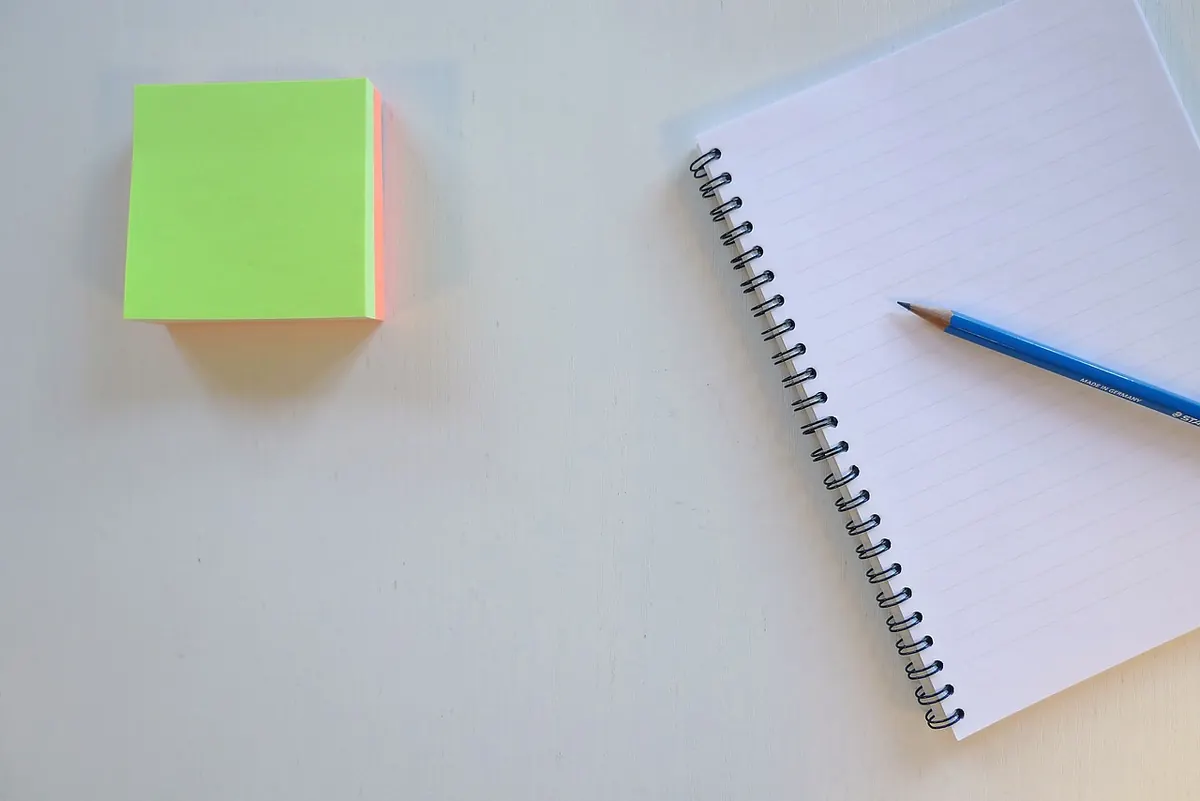
You have fifteen minutes before you need to leave the house, and the blank page is doing what it always does. Sitting there. Waiting. Most writers don't need more hours in the day; they need a way into the work that costs almost nothing and asks for even less. That is what a warm-up is for: a small, timed exercise that moves your attention from the noise of the day to the sentence in front of you.
Five minutes is enough. Not because you will produce anything worth keeping — you usually won't, and that is the point — but because the writing muscles respond to use rather than intention. Keep a notebook, a timer and a willingness to write badly for a few minutes, and you will arrive at the real work already moving.
Why a warm-up beats a running start
The temptation when time is short is to go straight at the main project. Occasionally that works. More often you spend twenty minutes rereading yesterday's pages, tweaking a sentence, opening a different document to check one fact, and then the window has closed.
A warm-up sidesteps all of that by giving you a task so small that perfectionism has nothing to grip. Three rules make the difference:
- Set a timer. Five minutes, visible on the desk, not on the phone you are also using to check messages.
- Don't edit. Cross out a word if it truly irritates you, then keep going. Rewriting is for later.
- Stop mid-sentence if you can. Coming back to a half-finished line is easier than starting from nothing.
Four exercises to loosen stiff prose
- The sentence ladder. Write one sentence of five words. Then six. Then seven, and so on up to twenty. Keep the subject ordinary — a kettle, a bus stop, a pair of boots — and let the sentence length do the work. Most writers discover they have been living at a comfortable eleven words and that variety changes the whole texture.
- Copy by hand. Choose a page of prose whose sentences you envy and copy about 150 words longhand. Not to imitate the style, but to feel the rhythm in your wrist: where the commas land, how often a short sentence follows a long one. Type it if longhand is impractical, but slower is better here.
- The no-adjective run. Describe a room you know well without using a single adjective or adverb. Barren, moody, clichéd — you'll feel all three after a paragraph, and then you'll start reaching for concrete nouns and precise verbs, which is where the good writing lives.
- Cut a paragraph by a fifth. Take anything you wrote recently and remove roughly twenty per cent of the words without losing the meaning. This one doubles as editing practice and as a reminder of how much padding hides in a first draft.
Four exercises to spark ideas
- Two objects, one person. Pick two unrelated items — a bent teaspoon and a hospital wristband, say — and put them in the same pair of hands. Write only about the hands and what they do with the objects. Backstory tends to arrive on its own.
- The overheard line. Take a scrap of speech you half-caught in a queue or on a train, change the words enough that nobody could be identified, and write what happened five minutes before it was said. Remember: change it, don't transcribe it.
- Start after the argument. Write the scene you have been avoiding, but begin once the confrontation is already over. The aftermath usually carries more charge than the shouting, and it stops you from writing the obvious version.
- What's in the drawer. Describe the contents of a drawer whose owner never appears. Be specific about the mundane: receipts, a spare key, a dried-out pen. The reader will assemble the person for you.
Four exercises for voice, character and detail
- Answer as someone else. Take a question you were asked today — How was your weekend? — and answer it in the voice of a character. Formal, evasive, over-friendly, whatever fits. Ten lines is plenty.
- The seven-word introduction. Introduce a character in seven words. Then again in twenty. Then again in a hundred. The compression forces you to decide what actually matters about them.
- Weather as mood. Write the same street twice, once in rain and once in a heatwave, without naming a single emotion. If a reader can tell how the character feels by the end, the detail is doing its job.
- One sense only. A hundred words built entirely from sound: a corridor, a kitchen at midnight, a swimming pool. Then try the same scene using only smell. Awkward, but it breaks the habit of defaulting to what things look like.
If you only have time for one
The sentence ladder and the seven-word introduction are the two worth keeping when the clock is genuinely tight. Both take under three minutes, both require nothing but a pen, and both leave you with something you can use.
Making the habit stick
A warm-up only helps if it happens before the writing, not instead of it. Anchor it to something you already do: the kettle boiling, the train journey, the ten minutes after the children leave for school. Keep the exercises in one notebook so you can flip back rather than invent a task from scratch each morning.
Resist the urge to turn the warm-up into a project. The moment one of these pieces starts to feel like a short story you must finish, it has stopped being a warm-up and become a way of avoiding the real work. Write it, close the notebook, move on.
Finally, be generous with yourself about quality. A warm-up that produces twelve bad sentences has done its job perfectly; the aim is to arrive at your desk with the engine running, not to impress anybody. Five minutes, most days, will change how the following hour feels — and that quiet shift is the whole point.
Photo: congerdesign / Pixabay